Welcome to the Sacred Stones project of the Abbey of New Clairvaux!
The Sacred Stones project is the reconstruction of an 800 year old Chapter House from a Cistercian monastery in Ovila, Spain. Considered the most important room in a monastery, this historic structure is being rebuilt at the Abbey of New Clairvaux in Vina, California.
After a journey of thousands of miles and taking nearly 80 years, new life is being breathed into these stones. Their new home, a community in the fertile soil of the Sacramento Valley, seems an unlikely place for such a magnificent building. We invite you to explore the rich history of the Chapter House and the Abbey of New Clairvaux. Join people from around the world who have become supporters of our project and share a common belief that these stones are, indeed, sacred. Guests on retreat at the Abbey of Our Lady of New Clairvaux:
Seldom in our lives are we presented with something so unlikely. As someone who lives in North America where the ancient past is considered 50 years, what are our chances to chant Compline in an 800 year old Spanish Monastery's Chapter House, or any 800 year old structure? Even if we could make a pilgrimage to Spain we would find the main building of the Spanish Monastery has moved to Vina, California. William Randolf Hearst had workmen disassemble the Chapter House (built by the Monks, 1190-1220) and ship it to San Francisco in 1930. He had a vision to construct a bigger and more magnificent "Hearst Castle", and the Chapter House would be a key element. He lost interest as he lost in the 30's economy, and the limestone 'stones' gathered moss in Golden Gate Park in San Francisco. The first Abbott of New Clairvaux petitioned the City to buy the stones for reassembly on the grounds of The Cistercian Abbey of New Clairvaux. They accepted his bid of $1 and shipped the stones to the Abbey where they were slowly reassembled by skilled stone masons. Some stones were pilfered from the Park over time and the masons had to improvise with some new pieces. On a men's retreat of the Holy Trinity Episcopal Church (est.1854) in Nevada City CA, we decided to chant Compline in the confines of the 'sacred stones', as they are called. We had two men who had sung compline before and two volunteers who could read music. I put a simple, Medieval Compline together in book form and we had one rehearsal with the two that had never sung Compline before. The result was authentic, if not great. It was a truly Mystical experience. You simply were not in the here and now. The 'Stones' seemed to radiate some ancient vibes of worship long past. |
 Updates:
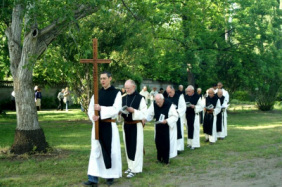
Visio Divina God speaks to us in many ways-through relationships, our experiences, sacred texts such as the Bible and many more. Visio divina, Latin for divine seeing, is praying with images to listen to God's words. In an effort to stay in closer contact with our friends, we would like to include you in our monthly updates from the abbey. The monks remember all of our friends in daily prayers and invite you to enjoy a quiet moment of reflection in the presence of God's Glory. Philippians 2:3-4 Do nothing from selfishness or empty conceit, but with humility of mind regard one another as more important than yourselves; do not merely look out for your own personal interests, but also for the interests of others. |
